I am confused about problem II.6.10 b) in Hartshorne's Algebraic Geometry. The question goes:
For a scheme $X$ let $K(X)$ be the Grothendieck group of coherent sheaves on $X$, i.e. the free abelian group generated by isomorphism classes of coherent sheaves, modulo the relations $\mathcal{F}-\mathcal{F'}-\mathcal{F''}$ for each exact sequence $0\rightarrow\mathcal{F'}\rightarrow\mathcal{F}\rightarrow\mathcal{F''}\rightarrow0$.
Now, fix $X$ to be a Noetherian scheme, and $Z$ a closed subscheme. Then show that there is an exact sequence $$ K(Z)\rightarrow K(X) \rightarrow K(X-Z)\rightarrow 0 $$
where the first arrow is pushforward and the second is restriction.
I am having difficulty showing that an arbitrary class in $K(X)$ that goes to zero once restricted to $X-Z$ is in the image of the first map. There is a hint that basically tells you how to show that for $\mathcal{F}$ a coherent sheaf on $X$ with support contained in $Z$, $\mathcal{F}$ is in the image of $K(Z)$, but I do not know how to reduce to this case, from starting with a general class in $K(X)$ which may at best be a difference of classes of coherent sheaves.

The following proof is adapted from Grothendieck's original proof in [SGA6, Exp. 0, App., Prop. 2.10], although my argument ended up being much longer since I couldn't verify some of the statements he gives.
If $P$ is an object of an essentially small abelian category $\mathcal{A}$, then we denote $\beta(P)$ to be its associated isomorphism class in the free abelian group generated by all isomorphism classes of coherent sheaves on $\mathcal{A}$, and $\gamma(P)$ to be the image of $\beta(P)$ in the Grothendieck group $K(\mathcal{A})$ of $\mathcal{A}$. When $\mathcal{A}$ is the category of coherent sheaves on a noetherian scheme $X$ (which is essentially small by [ATJLPRVG, Thm. 4.2]), we denote $\beta$ and $\gamma$ by $\beta_X$ and $\gamma_X$, respectively.
We will need the following:
Lemma 1 [Weibel, Ch. II, Exer. 6.4]. Let $\mathcal{A}$ be an essentially small abelian category, and let $K(\mathcal{A})$ be its Grothendieck group. If $A_1,A_2$ are two objects of $\mathcal{A}$ such that $\gamma(A_1) = \gamma(A_2)$ in $K(\mathcal{A})$, then there are objects $C',C''$ in $\mathcal{A}$ and two extensions $$\label{eq:extns}\tag{1} 0 \longrightarrow C' \longrightarrow C_1 \longrightarrow C'' \longrightarrow 0, \qquad 0 \longrightarrow C' \longrightarrow C_2 \longrightarrow C'' \longrightarrow 0 $$ in $\mathcal{A}$, such that $A_1 \oplus C_1 \simeq A_2 \oplus C_2$.
Proof. By definition of $K(\mathcal{A})$, there exist short exact sequences $$\label{eq:relns}\tag{2} 0 \longrightarrow D_i' \longrightarrow D_i \longrightarrow D_i'' \longrightarrow 0, \qquad 0 \longrightarrow D_j' \longrightarrow D_j \longrightarrow D_j'' \longrightarrow 0, $$ such that $$ \beta(A_1) - \beta(A_2) = \sum_i \bigl(\beta(D_i) - \beta(D_i') - \beta(D_i'')\bigr) - \sum_j \bigl(\beta(D_j) - \beta(D_j') - \beta(D_j'')\bigr), $$ and so rearranging terms, we have $$ \beta(A_1) + \sum_i \bigl(\beta(D_i') + \beta(D_i'')\bigr) + \sum_j \beta(D_j) = \beta(A_2) + \sum_j \bigl(\beta(D_j') + \beta(D_j'')\bigr) + \sum_i \beta(D_i). $$ In $\mathcal{A}$, we therefore have $$ A_1 \oplus \underbrace{\bigoplus_i (D_i' \oplus D_i'') \oplus \bigoplus_j D_j}_{C_1} \simeq A_2 \oplus \underbrace{\bigoplus_j (D_j' \oplus D_j'') \oplus \bigoplus_i D_i}_{C_2} $$ and we define $C_1,C_2$ as indicated. To show the existence of the extensions in \eqref{eq:extns}, we have the exact sequences
$\hskip1.375in$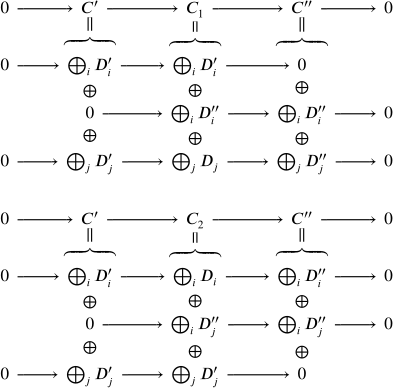
where the bottom row of the first diagram and the top row of the second diagram are formed by taking direct sums of the sequences in \eqref{eq:relns}. $\blacksquare$
We now move to the setting of the question. Let $U = X \smallsetminus Z$.
Lemma 2. Let $\mathscr{F}$ and $\mathscr{G}$ be two coherent sheaves on $X$ such that $\mathscr{F}\rvert_U \simeq \mathscr{G}\rvert_U$. Then, we have $$ \gamma_X(\mathscr{F}) - \gamma_X(\mathscr{G}) = \gamma_X(\mathscr{R}) - \gamma_X(\mathscr{S}) $$ for some coherent sheaves $\mathscr{R}$ and $\mathscr{S}$ on $X$ with support in $Z$.
Proof. We consider the graph $\Gamma$ of an isomorphism $\varphi\colon\mathscr{F}\rvert_U \overset{\sim}{\to} \mathscr{G}\rvert_U$, defined as the image of $(\mathrm{id},\varphi)$ in $\mathscr{F}\rvert_U \oplus \mathscr{G}\rvert_U$. The graph fits into the commutative diagram
$\hskip2.625in$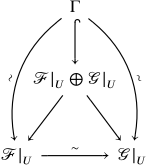
where the morphisms from $\mathscr{F}\rvert_U \oplus \mathscr{G}\rvert_U$ are the two projections. Since $\Gamma$ is coherent, by Chapter II, Exercise 5.15(d), there exists a coherent subsheaf $\widetilde{\Gamma}$ in $\mathscr{F} \oplus \mathscr{G}$ such that $\widetilde{\Gamma}\rvert_U = \Gamma$, and such that we have the commutative diagram
$\hskip2.75in$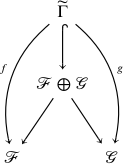
where the morphisms $f$ and $g$ are defined by composition with the projections from $\mathscr{F} \oplus \mathscr{G}$. Since $f$ and $g$ become isomorphisms once restricted to $U$, we have the exact sequences \begin{gather} 0 \longrightarrow \mathscr{K}_1 \longrightarrow \widetilde{\Gamma} \overset{f}{\longrightarrow} \mathscr{F} \longrightarrow \mathscr{Q}_1 \longrightarrow 0\\ 0 \longrightarrow \mathscr{K}_2 \longrightarrow \widetilde{\Gamma} \overset{g}{\longrightarrow} \mathscr{G} \longrightarrow \mathscr{Q}_2 \longrightarrow 0 \end{gather} where $\mathscr{K}_i$ and $\mathscr{Q}_i$ are supported in $Z$ for $i = 1,2$. We therefore obtain \begin{align} \gamma_X(\mathscr{F}) - \gamma_X(\mathscr{G}) &= \bigl(\gamma_X(\widetilde{\Gamma}) + \gamma_X(\mathscr{Q}_1) - \gamma_X(\mathscr{K}_1)\bigr) - \bigl(\gamma_X(\widetilde{\Gamma}) + \gamma_X(\mathscr{Q}_2) - \gamma_X(\mathscr{K}_2)\bigr)\\ &= \gamma_X(\mathscr{Q}_1 \oplus \mathscr{K}_2) - \gamma_X(\mathscr{K}_1 \oplus \mathscr{Q}_2) \end{align} and setting $\mathscr{R} = \mathscr{Q}_1 \oplus \mathscr{K}_2$ and $\mathscr{S} = \mathscr{K}_1 \oplus \mathscr{Q}_2$, we are done. $\blacksquare$
We can finally move on to the main proof.
Main Proof. We would like to show that every element in the kernel of $K(X) \to K(U)$ is in the image of $K(Z) \to K(X)$. By Eoin's comment, we may assume that such an element is of the form $$ \gamma_X(\mathscr{A}_1) - \gamma_X(\mathscr{A}_2). $$ By assumption, we have $$ \gamma_U(\mathscr{A}_1\rvert_U) - \gamma_U(\mathscr{A}_2\rvert_U) = 0 $$ in $K(U)$, hence by Lemma 1, we have an isomorphism $$ \mathscr{A}_1\rvert_U \oplus \mathscr{C}_1 \longrightarrow \mathscr{A}_2\rvert_U \oplus \mathscr{C}_2 $$ for some coherent sheaves $\mathscr{C}_1$ and $\mathscr{C}_2$ on $U$ which fit into short exact sequences as in \eqref{eq:extns}. Now for each $i = 1,2$, let $\widetilde{\mathscr{C}}_i$ be coherent sheaves on $X$ such that $\widetilde{\mathscr{C}}_i\rvert_U = \mathscr{C}_i$; these exist by Chapter II, Exercise 5.15. We then have that $\mathscr{A}_1 \oplus \widetilde{\mathscr{C}}_1$ and $\mathscr{A}_2 \oplus \widetilde{\mathscr{C}}_2$ are coherent sheaves on $X$ that have isomorphic restrictions on $U$, hence by Lemma 2, $$\label{eq:almost}\tag{3} \gamma_X(\mathscr{A}_1) - \gamma_X(\mathscr{A}_2) = \gamma_X(\widetilde{\mathscr{C}}_2) - \gamma_X(\widetilde{\mathscr{C}}_1) + \gamma_X(\mathscr{R}) - \gamma_X(\mathscr{S}) $$ for some coherent sheaves $\mathscr{R}$ and $\mathscr{S}$ with support in $Z$. By applying Chapter II, Exercise 5.15(d) to $\widetilde{\mathscr{C}}_i$ for $i = 1,2$ and the inclusions in the short exact sequences in \eqref{eq:extns}, we have two short exact sequences $$ 0 \longrightarrow \widetilde{\mathscr{C}}'_1 \longrightarrow \widetilde{\mathscr{C}}_1 \longrightarrow \widetilde{\mathscr{C}}''_1 \longrightarrow 0, \qquad 0 \longrightarrow \widetilde{\mathscr{C}}'_2 \longrightarrow \widetilde{\mathscr{C}}_2 \longrightarrow \widetilde{\mathscr{C}}''_2 \longrightarrow 0 $$ such that $\widetilde{\mathscr{C}}'_1$ and $\widetilde{\mathscr{C}}'_2$ are equal to $\mathscr{C}'$ when restricted to $U$, and similarly, $\widetilde{\mathscr{C}}''_1$ and $\widetilde{\mathscr{C}}''_2$ are isomorphic to $\mathscr{C}''$ when restricted to $U$. By Lemma 2, we therefore have \begin{align} \gamma_X(\widetilde{\mathscr{C}}_2) - \gamma_X(\widetilde{\mathscr{C}}_1) &= \bigl(\gamma_X(\widetilde{\mathscr{C}}'_2) + \gamma_X(\widetilde{\mathscr{C}}''_2)\bigr) - \bigl(\gamma_X(\widetilde{\mathscr{C}}'_1) + \gamma_X(\widetilde{\mathscr{C}}''_1)\bigr)\\ &= \gamma_X(\mathscr{R}') - \gamma_X(\mathscr{S}') + \gamma_X(\mathscr{R}'') - \gamma_X(\mathscr{S}''). \end{align} Combining this equation with \eqref{eq:almost}, we obtain $$ \gamma_X(\mathscr{A}_1) - \gamma_X(\mathscr{A}_2) = \gamma_X(\mathscr{R}) - \gamma_X(\mathscr{S}) + \gamma_X(\mathscr{R}') - \gamma_X(\mathscr{S}') + \gamma_X(\mathscr{R}'') - \gamma_X(\mathscr{S}''). $$ Now by the hint Hartshorne gives, each of these classes on the right are in the image of $K(Z)$ since their respective representatives are coherent sheaves supported on $Z$. $\blacksquare$