Find the equation of the diameter of $3x^2+4y^2=5$ conjugate to the diameter $y+3x=0$.

2.5k Views Asked by At

Find the equation of the diameter of $3x^2+4y^2=5$ conjugate to the diameter $y+3x=0$.

Two problems:

  1. The given equation is that of an ellipse $\dfrac{x^2}{\frac{5}{3}}+\dfrac{y^2}{\frac{5}{4}}=1$ with $a={\frac{\sqrt 5}{\sqrt 3}}$ and minor axis ${\frac{\sqrt 5}{2}}$.

How to find the diameter of an ellipse?

  1. How to find the equation conjugate to the diameter $y+3x=0$?

Please give some hints on the problem

3

There are 3 best solutions below

2
On BEST ANSWER

Using the definition "Any chord that passes through the center of an ellipse is call its diameter.",

$$y=mx$$ is a diameter of the given ellipse where $m$ is the gradient.

Using this, " two diameters are conjugate if and only if the tangent line to the ellipse at an endpoint of one diameter is parallel to the other diameter."

$$3x^2+4y^2=5\implies3(2x)+4(2y)\dfrac{dy}{dx}=0\implies\dfrac{dy}{dx}=-\dfrac{3x}{4y}$$

We don't exactly need to find the endpoints as any point of $y+3x=0$ can be chosen to be $(a,-3a)$

So, the gradient at the endpoints will be $$-\dfrac{3x}{4y}=-\dfrac{3a}{4(-3a)}=\dfrac14$$

Can you find the equation of conjugate diameter now?

0
On

HINT

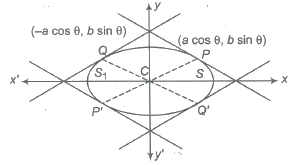
Let’s use the following construction ($PP’$ and $QQ’$ are conjugate diameters):

enter image description here

Moreover

$$6x\, dx + 8y\, dy=0 \implies \frac{dy}{dx}=\frac{-3x}{4y}$$

Now plug in the line equation and find the angular coefficient of the tangent in $P$ and $P'$.

0
On

The conjugate of a diameter of an ellipse is parallel to the tangent lines at the points of intersection of the given diameter with the ellipse. For a circle, this is the perpendicular to the given diameter. Every ellipse is the affine image of a circle, and since affine transformations preserve intersections, conjugate diameters of an ellipse are images of perpendicular diameters of a circle.

An ellipse in standard position is obtained from the unit circle by scaling the $x$-axis by $a$ and the $y$-axis by $b$, which multiplies slopes of lines by $\frac b a$. Horizontal and vertical lines aside, the product of the slopes of perpendicular lines is $-1$, therefore the product of the slopes of conjugate diameters of an ellipse in standard position is $-{b^2\over a^2} = 1-e^2$. This should be enough to let you find the slope, and hence the equation, of the conjugate to the diameter $3x+y=0$.


For fun, here’s a projective-geometric approach with a direct computation:

The conjugate diameter is the line through the center of the ellipse and the point at infinity of the tangent lines at the intersections of the given diameter with the ellipse. This is the intersection point of the tangents, so is the given diameter’s pole. The center of the ellipse is the pole of the line at infinity, so if $C$ is the matrix of the ellipse and $\mathbf l$ a diameter, the conjugate diameter is $$(C^{-1}\mathbf l)\times(C^{-1}\mathbf l_\infty) = (\det C)C(\mathbf l \times \mathbf l_\infty).$$ In other words, the conjugate diameter is the polar of the diameter’s intersection with the line at infinity—its direction vector. We can, of course, drop the factor of $\det C$ since we’re dealing with homogeneous coordinates. The cross product with $\mathbf l_\infty$ is essentially a 90° rotation, and so for an ellipse in standard position, this leads directly to a rather simple expression for the conjugate diameter of the line $\lambda x+\mu y=0$, namely ${\mu \over a^2}x-{\lambda \over b^2}y=0$. You can verify that the product of the slopes of these lines is $-{b^2 \over a^2}$, just as above.