Why is the following true ?
$$\limsup\limits_nX_n<\infty\Longrightarrow \sup_n X_n<\infty$$
where, $X_n's$ are random variables.
If we consider only finitely many $X_n$, say $n\in\{1,...,m\}$ then every $X_n$ must have a finite output, since they're random variables, so if we also have $\limsup\limits_nX_n<\infty$, then $X_n$ is finite for all $n$. Is that true ?
Thanks.
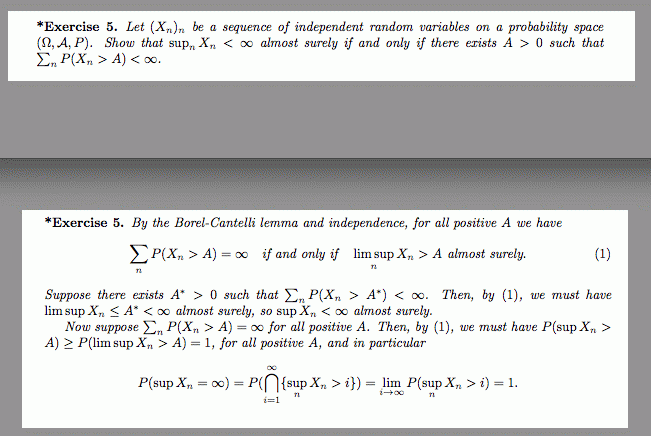
EDIT: here is link, where I encountered this problem ($4$th line of the solution).

I don't think this is true in general. $\limsup_n X_n<\infty$ means that $\sup_{k\geq n} X_k$ will converge (and decrease down) to finite number when $n$ large. So this says nothing about $X_n$ for small $n$, some of which may misbehave.