I am having some trouble wrapping my head around the formalization to this. I'm working in $\mathbb{R}$ here for simplicity.
We say a set $S$ is closed if the set contains all its limit points. A limit point is a point where any positive-radius ball we draw around it must include points inside $S$ (or does it suffice to say "at least one point in $S$"? Anyway...). I also don't know if balls include points on the border of the radius or not. Anyhow if $S$ is open then this means $S$ includes the points on its "border" since such a point will have a ball that must overlap $S$'s territory.
An open set, in contrast, is a set $S$ such that any point belonging to $S$ we can make a positive-radius ball around it that is fully inside $S$. This means it does not include the "border" points since part of their ball will be inside $S$ and the other part will be outside of it.
Now the complement of $S$ is everything outside of $S$, which I believe is denoted $S^C$. Let's assume $S$ is an open set. That means every point belonging to $S$ has a ball fully inside $S$. Therefore these balls do not contain anything in $S^C$, which by definition means they are not limit points of $S^C$. That means any limit point of $S^C$ must belong to $S^C$. And if $S^C$ contains all its limit points that must mean it is closed by definition.
This seems right to me but is there a way to formally describe everything that's going on so there's a more rigorous way to express all these concepts rather than relying on this sort of mental picture I am using? I don't really know what it means formally to be a ball, or to "overlap", or to be "in" a set, or "on" a border, or to be a limit point, or a point with a ball inside the set, etc etc etc.

since I taught you those definitions, perhaps I should formalize them:
1) A metric space $X$ is a set of element, and a "rule" called a metric to define what the "distance" between any two point is. $d(x,y) =$ the "distance" between $x$ and $y$.
$d(x,y)$ must follow the following rules:
1) $d(x,y) \ge 0$. A distance is always non-negative real value.
2) $d(x,y) = 0 \iff x=y$. Every two distinct points are always some real positive distance apart. There is never any distance between a point and itself.
3) $d(x,y) = d(x,y)$. Going from point $a$ to point $b$ is the same distance as going from point $b$ to point $a$.
4) $d(x,z) \le d(x,y) + d(y, z)$. The triangle inequality. Two legs of a triangle add up to more than the third leg. Going for point $x$ and $z$ directly is shorter than taking a side trip for $x$ to $y$ and then $y$ to $z$ (unless $y$ is directly in line with $x$ and $z$ in which case it is equal.)
In $\mathbb R$, $d(x,y) = |x - y|$ and in $\mathbb R^2$, $d((x_1,y_1),(x_2,y_2)) = \sqrt{(x_1 - x_2)^2 + (y_1 + y_2)^2}$ are examples of metrics but they aren't the only ones. Anything that satifies the rules is a metric space.
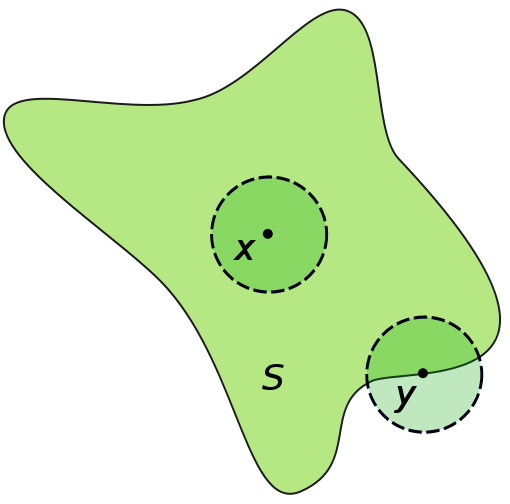
For a point $x$ in the metric space an "open ball" or a "neighborhood" of $x$ is the set of all points $y$ so that $d(x,y) < r$ for some $r > 0$. (In $\mathbb R$ with the euclidean metric this is all points $y$ so that $|x-y| < r$.)
An "interior" point of a set $A$ is a point $a \in A$ so that there exist some neighbor hood (in other words a distance $r$) so that all the points in the neighborhood (in other words all $y$ so that $d(x,y) < r$) are in $A$. (in other words so that $\{y|d(x,y) < r \} \subset A$.
A "limit point" of a set $A$ is a point $y$ (maybe in $A$; maybe not) so that for every neighborhood of $y$ (no matter how small an $r$ we choose), every neighborhood of $y$ will contain a point, not equal to $y$, that is in the set $A$.
A set is called "open" if every point is an interior point.
A set is called "closed" if all its limit points are in the set. Or alternatively, if none of the points not in the set are limit points.
Theorem: A set $A$ is open, if and only if $A^c = \{y \in X| y \not \in A\}$ is closed.
Pf: If $A$ is open then all points in $A$ are interior points. So for every point $a\in A$ there is a neighborhood that is entirely a subset of $A$. That means the neighborhood does not contain any points not in $A$. So it does not contain any point of $A^c$. So it is not a limit point of $A^c$. So none of the limit points of $A^c$ are in $A$. So all the limit point os $A^c$ (if any) are in $A^c$. So $A^c$ is closed.
If $A^c$ is closed then none of the points of $A$ are limit points of $A^c $. So and if $a \in A$ then $a$ is not a limit point. That means not every neighborhood around $a$ contains a point of $A^c$. THat means there is some neighborhood of $a$ that doesn't have any points in $A^c$. That means all the points of the neighborhood of $a$ are all in $A$. So $a$ is an interior point of $A$. That is true of all points of $A$. So $A$ is open.