How does one graph a summation, like $$\sum_{x=0}^{n} n$$
Can it be like this
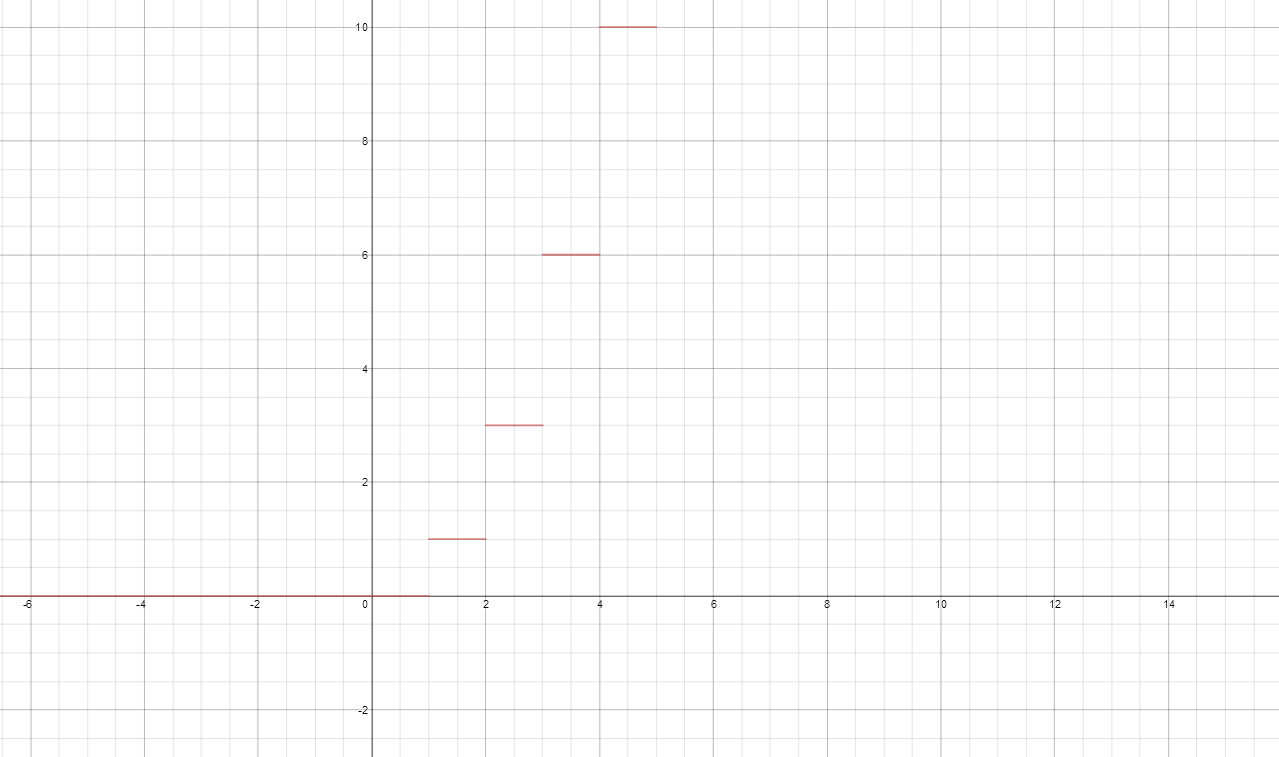
Because if you take the points from the summation (0,0), (1,1), (2,3), (3,6) you can tell by summations it only works with integers, so after that integer, like a floor function, it should stay prolonged for one unit until the next integer.
I personally thinks this is how it should be graphed. If this is how the graph looks I think we can easily formulate the integral. If go backwards the limit is 0, in the summations so it's 0.
As for the reason it's like a floor function, if these are fixed points, taking x=1.5, you could just say undefined, but then there's not much you can solve from it. You could say it's discrete, but then is a summation a function, if there is no infinitesimal parts for all x-values, should it just be the way it is?
This may sound off topic, but is there an identity for the integral of any summation, and what is it called? Because if you take $\int\sum_{x=0}^{n} n^n$, you can't find the partial sum for it, so you'll have to introduce another notation.

One function that will produce the given graph is $$ f(x)= \sum_{k=1}^{\lfloor x \rfloor} k = \frac{\lfloor x \rfloor \cdot \lfloor x + 1 \rfloor}{2} $$ provided $x \geq 0$ and $f(x)=0$ if $x < 0$. Here $\lfloor x \rfloor$ denonotes the floor function, i.e., decimal truncation.
If you restrict the domain of $f$ to set bounded from above then you can realize it as the finite sum of simple functions, where each simple function is a "step" of the graph. More specifically, on any interval $(-\infty, x]$ for $x \geq 0$ we have the functional equality $$ f = \frac{\lfloor x \rfloor \cdot \lfloor x + 1 \rfloor}{2} \cdot \chi_{[\lfloor x \rfloor, x]} + \sum_{k=0}^{\lfloor x \rfloor - 1} \frac{k (k+1)}{2} \chi_{[k, k+1)}. $$ We adopt the convetion that the rightmost sum is $0$ if $\lfloor x \rfloor < 1$. Here, for any subset $A$ of the real numbers $\chi_A$ denotes the indicator function of $A$, defined by $\chi_A(x)=1$ if $x \in A$ and $\chi_A(x)=0$ if $x \notin A$. The reason for writing $f$ this way becomes apparent when we want to integrate it. More generally, for a function $g \colon \mathbb R \to \mathbb R$ that can be written as $g = \sum_{k=1}^n \alpha_k \cdot \chi_{I_k}$ for reals $\alpha_k$ we have $\int_{\mathbb R} g(x) \ dx = \sum_{k=1}^n \alpha_k \cdot \lvert I_k \rvert$.
Clearly $\int_{\mathbb R} f(x) \ dx$ is infinite, but for $x \geq 0$ $$ \int_{-\infty}^x f(t) \ dt = (x - \lfloor x \rfloor) \cdot f(x) + \sum_{k=0}^{\lfloor x \rfloor -1} f(k). $$ The rightmost expression is just of the form $\sum_{k=1}^m \left( \sum_{j=1}^k j \right)$ which can be seen to equal $(1/6)m(m+1)(m+2)$.