Given $n$ randomly drawn Set cards on a table from a standard 81-card deck, how can I determine the probability of one or more Sets existing on the table?
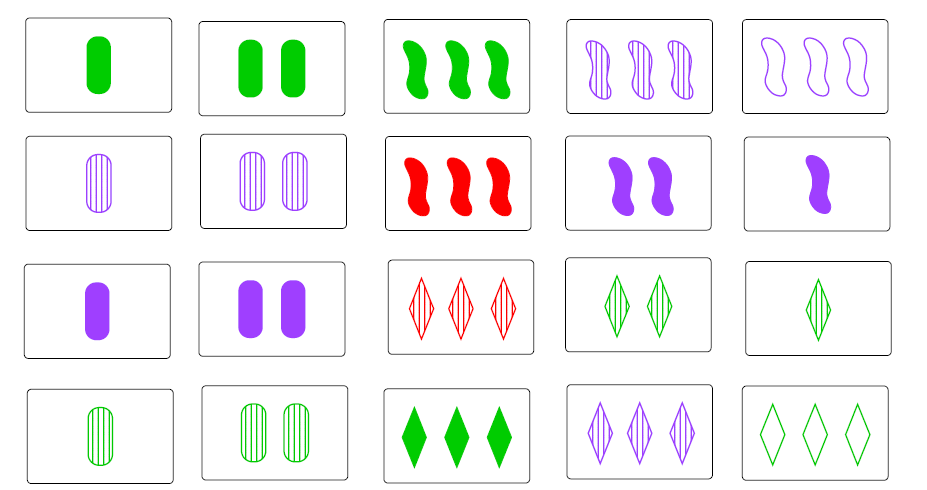
First, for those who may not be familiar with the game, here's a simple introduction to Set (see setgame.com), which lends itself to some straightforward mathematics: there are four properties of the symbols on each card. Each property has three states, resulting in $3^4$ or 81 possible symbols. Each of the 81 cards is unique.
The properties are as follows: Number, Shading, Color, and Shape.
The three states of Number: One, Two, Three.
The three states of Shading: Open, Lined, Solid.
The three states of Color: Red, Green, Purple.
The three states of Shape: Diamond, Oval, Squiggle.
A Set is defined by three cards in which each property is either all the same across the three cards (e.g. Two, Two, Two), or all different across the three cards (e.g. Red, Green, Purple). You must consider all four properties when determining the validity of a Set.
Hence the following are Sets:
- One Lined Red Diamond, Two Lined Green Diamonds, and Three Lined Purple Diamonds
- One Solid Green Oval, One Solid Green Diamond, One Solid Green Squiggle
- One Lined Purple Squiggle, Two Solid Red Diamonds, Three Open Green Ovals.
And, just for kicks, the following is not a Set:
- One Open Green Diamond, Two Lined Green Diamonds, and Two Solid Green Diamonds; the number property does not pass the test (1, 2, 2)
The game is played by one or more players placing twelve cards (random, from a shuffled deck) face up on a flat area. When a player sees a Set, s/he calls "Set" and indicates the three cards, collects them from the table, and the dealer replaces them. When the deck runs out, and no more Sets are possible, whoever has the most Sets wins.
Hopefully you have the gist of it now. Here's the question again, in light of the rules: given a shuffled 81-card deck, when you lay out $n$ cards face up on a table, what is the probability of a Set existing on the table?
I have been able to figure it out to five cards, but past that, I get lost. I'll post what I have in an answer, because it's part of the answer, but what I really want to know is whether there's an easier way to do it. Otherwise it could take me a long time, no kidding.

It turns out that Don Knuth wrote programs to compute these values in 2001. The WEB programs are available here, and a WEB-to-C compiler is available here (it worked out of the box on my Mac). I ran the faster of the two programs, setset-all, in which Knuth used a much larger isomorphism group to make use of the symmetries. It only took a couple of minutes to complete on my Mac. Here's the output:
Dividing by $\binom{81}n$ and subtracting from $1$ yields the following proportions of sets with Sets:
$$ \begin{array}{rc} 1&0.00000000000000\\ 2&0.00000000000000\\ 3&0.01265822784810\\ 4&0.05063291139241\\ 5&0.12411638993917\\ 6&0.23702812843386\\ 7&0.38339288958876\\ 8&0.54646648344183\\ 9&0.70277715297383\\ 10&0.83054958637630\\ 11&0.91824367776036\\ 12&0.96769802141450\\ 13&0.98997192274043\\ 14&0.99768669219781\\ 15&0.99963531493045\\ 16&0.99996602550906\\ 17&0.99999862737549\\ 18&0.99999998580641\\ 19&0.99999999999099\\ 20&0.99999999999985\\ 21&1.00000000000000\end{array} $$