I want to calculate x,y coordinates of Morley Triangle for given triangle:
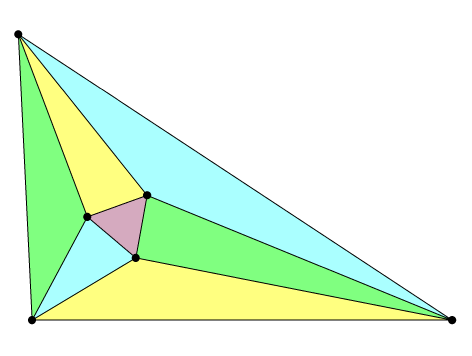
Image source Wikimedia commons by Tosha; CC-By-SA
If I have the coordinates of the points I can calculate the angles of bigger triangles and the smaller triangles on the sides will have an angle / 3.
So to get the Morley triangle all I need is 3rd point of a triangle if I have two points and two angles. But I'm not sure how can I get that points x and y. I can't seem to find the answer on this Q&A.


(see figure below, obtained with GeoGebra) :
Here is a solution giving providing the exact coordinates of the vertices of the Morley triangle.
First of all, WLOG, it is possible to consider that the triangle $ABC$ is inscribed into the unit circle (see Remark at the bottom).
The "astute" idea is to write $A=a^3, B=b^3, C=c^3$ where $a,b,c \in \mathbb{C}$ (Remark: I don't make any distinction between a point and its so-called "affix").
In this way, the points where the different line trisectors meet the unit circle can be expressed by $a^2,b^2a,\cdots$ (see the figure ; do you understand why ?).
Then, with some calculations, we get the following expressions of the vertices $u,v,w$ of the Morley triangle :
\begin{cases} u&=&-b^2c-bc^2+ac^2+ab^2+abc\\ v&=&-c^2a\omega^2-ca^2\omega+ba^2+bc^2\omega^2+abc \omega\\ w&=&-a^2b \omega^2-ab^2 \omega + cb^2 \omega + ca^2 + abc \omega^2 \end{cases}
where $\omega$ stands for $e^{2i \pi/3}$.
All these calculations are adapted from a delicious 180 pages book written (in French) "Le Théorème de Morley" 1993, ADCS, by André Viricel, a late friend of mine.
Of course, the $(x,y)$ coordinates of $u,v,w$ are obtained by taking the real and imaginary parts of the expressions above.
Animation : one can upload the Geogebra file here and animate it by moving the little blue lozenges representing complex numbers $a,b,c$.
Remark : if the vertices of the initial triangle $T$ have the following complex representation : $z_1,z_2,z_3$, here is the "modus operandi".
It is possible to map $z_1,z_2,z_3$ onto points of the unit circle $z_1',z_2',z_3'$ by a certain transformation $f$ (translation + homothety) obtained in this way :
$$z_C^2=\tfrac13(z_1^2+z_2^2+z_3^2)$$
(caution in taking the complex square root : only one of the two solutions is the valid one).
The transformation is $z'=f(z)=\frac{1}{r}(z-z_C)e^{i \alpha}$.
(where $\alpha$ can take any value)
The complete chain of operations is
apply $f$ to initial triangle $T$
operate as we have done inside the unit circle
apply $f^{-1}$ to the results in order to reintegrate them in the framework of the initial triangle.