According to Archimedes, the perimeter of any circumscribed regular polygon is greater than the circumference of the circle.
ie:
http://www.themathpage.com/atrig/Trig_IMG/eval1.gif
This does seem graphically intuitive. Is this an axiom? Is there a fundamental property I'm missing? Does the answer to this depend on the definition of how one measures a circumference?
Please advise!

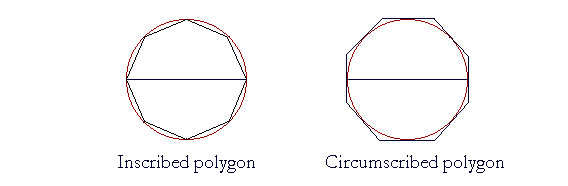
It most certainly depends on the definition of circumference. There are several definitions, all equivalent. (Showing they are equivalent makes for interesting mathematics, perhaps.)
For example, one of the equivalent definitions is: the circumference is the greatest lower bound of perimeters of all circumscribed polygons. If you use this definition, then the proposition is a direct consequence of the definition.
If you define the circumference as the least upper bound of perimeters of all polygons inscribed in the circle, this becomes more interesting. Challenge: show that if a convex polygon is entirely inside another convex polygon, then the outer polygon has perimeter greater than or equal to the inner one.
In Archimedes's times, it was OK to simply state "self-evident" truths like this one without providing a proof. (Of course, many of those statements were in fact false, and others have very difficult proofs.)