When sunlight casts a shadow on an axi-symmetric inside surface we have a $ plane$ determined by rim boundary $B$ projection $E$ and mid centers $C$ on rim that divides illuminated (white) and dark portions (gray is shadow of the bowl itself below $BC$ and yellow is shadow from semicircle radius $CB$) as shown.
One can satisfy this with a parabolic dish of meridian
$$ z = k\,r^2$$


How can we formulate this in general to include all meridians producing such shadow partition by a plane ?

This is not an answer, but a report of my findings. I am hoping that someone better at math can use these to actually answer the question.
Let's use a coordinate system where the base of the dish is at origin, the height of the dish is $h$, the radius of the rim is $r$. Let all light rays be parallel, with direction vector $(-1 , 0 , -m)$, $0 \lt m \in \mathbb{R}$. The light rays on the terminator cast by the rim of the dish fulfill $$z_\text{terminator}(x, y) = m \left(x - \sqrt{r^2 - y^2} \right) + h \tag{1}\label{NA1}$$ Note that $\eqref{NA1}$ applies to all dishes that have a circular rim of radius $r$ at $z = h$.
A parabolic dish with base at origin, height $h$, and rim radius $r$, can be defined by $$z_\text{dish}(x, y) = \frac{h}{r^2} \left( x^2 + y^2 \right) \tag{2}\label{NA2}$$ The light rays on the terminator cast by the dish rim intersect with the inside of the bowl when $0 \le z_\text{terminator}(x, y) = z_\text{dish}(x, y) \lt h$. Solving that for $x$ yields $$x_\text{terminator}(y) = \frac{m r^2 \pm \left\lvert m r^2 - 2 h \sqrt{r^2 - y^2} \right\rvert}{2 h} \tag{3}\label{NA3}$$ To locate the $y$ coordinate where the terminator intersects the rim, we substitute $\eqref{NA3}$ into $z_\text{dish}(x,y) = h$, and solve for $y$. The result is $$y_\text{rim} = \pm r \sqrt{1 - \frac{m^2 r^2}{4 h^2}} \tag{4a}\label{NA4a}$$ From $z_\text{terminator}(x, y_\text{rim}) = h$ we can solve the corresponding $x$ coordinate: $$x_\text{rim} = \frac{m r^2}{2 h} \tag{4b}\label{NA4b}$$ and obviously $z_\text{rim} = h$.
Note that $(x_\text{rim}, y_\text{rim}, z_\text{rim})$ is not the point $C$ in OP's diagram; it is to the right of it. Here is an orthographic projection of $h = 0.5$, $r = 1$, $m = 0.2$ I raytraced in POVRay: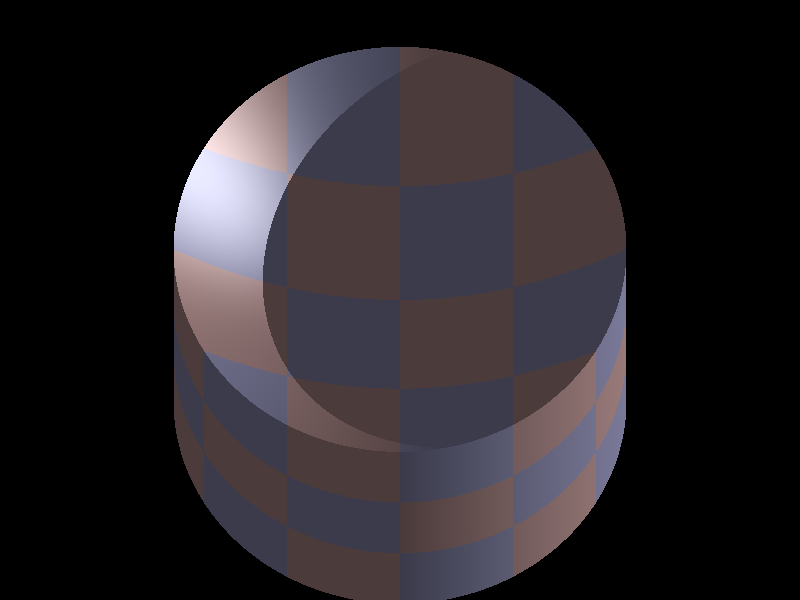 Note that light comes from right, and the dish is an indentation in the cylinder.
If the slope of the light is small enough, $m \lt \frac{2 h}{r}$, the absolute value term in $\eqref{NA3}$ is negative or zero for $-\lvert y_\text{rim} \rvert \lt y \lt \lvert y_\text{rim} \rvert$. Then, $$\left\lbrace\begin{aligned} x_\text{terminator}(y) &= \frac{m r^2}{h} - \sqrt{r^2 - y^2} \\ y_\text{terminator}(y) &= y \\ z_\text{terminator}(y) &= \frac{m^2 r^2}{h} - 2 m \sqrt{r^2 - y^2} + h \\ \end{aligned}\right., \quad \lvert y \rvert \lt \lvert y_\text{rim} \rvert, \; m \lt \frac{2 h}{r} \tag{4c}\label{NA4c}$$ where $z_\text{terminator}(y)$ was obtained by substituting $x_\text{terminator}(y)$ into $\eqref{NA1}$ or $\eqref{NA2}$ (both yield the same result).
We can test for planarity (via torsion), using the first, second, and third derivatives. The curve is planar if and only if $$\det \left [ \begin{matrix} \frac{t}{\sqrt{r^2 - t^2}} & \frac{r^2}{(r^2 - t^2)^{3/2}} & \frac{3 t r^2}{(r^2 - t^2)^{5/2}} \\ 1 & 0 & 0 \\ \frac{2 m t}{\sqrt{r^2 - t^2}} & \frac{2 m r^2}{(r^2 - t^2)^{3/2}} & \frac{6 m t r^2}{(r^2 - t^2)^{5/2}} \\ \end{matrix} \right ] = 0$$ This is indeed true for the parabolic dish.
Unfortunately, I don't see how to generalize this to other dish profiles, not even to $$z_\text{dish} = \frac{h}{r^{2 k}}\left( x^2 + y^2 \right)^k$$ except for $k = 1$ (the above parabolic dish case), and maybe $k = 1/2$. The issue is solving $z_\text{terminator}(x,y) = z_\text{dish}(x,y)$ for $x$ (to get $x_\text{terminator}(y)$).
Let's consider a right circular cylinder with radius $r$, axis along $z$ axis, and top at $z = h$. In this case, $$x_\text{cylinder}(y) = \pm\sqrt{r^2 - y^2}$$ and solving $\eqref{NA1}$ for $x$ yields $$x_\text{terminator}(y, z) = \sqrt{r^2 - y^2} + \frac{z - h}{m}$$ Solving $x_\text{cylinder}(y) = x_\text{terminator}(y, z)$ for $z$ yields $$z_\text{terminator}(y) = h - 2 m \sqrt{r^2 - y^2}$$ (and $z_\text{terminator}(y) = h$, but that is on the rim). i.e. the terminator curve is $$\left\lbrace\begin{aligned} x_\text{terminator}(t) &= -\sqrt{r^2 - t^2} \\ y_\text{terminator}(t) &= t \\ z_\text{terminator}(t) &= h - 2 m \sqrt{r^2 - t^2} \\ \end{aligned}\right .$$ where $x_\text{terminator}(t)$ was obtained by solving $z_\text{terminator}(y) = z_\text{terminator}(x, y)$ and solving for $x$. The torsion test (determinant of the matrix formed by the first three derivatives of the terminator curve) is again $$\det \left [ \begin{matrix} \frac{t}{\sqrt{r^2 - t^2}} & \frac{r^2}{(r^2 - t^2)^{3/2}} & \frac{3 t r^2}{(r^2 - t^2)^{5/2}} \\ 1 & 0 & 0 \\ \frac{2 m t}{\sqrt{r^2 - t^2}} & \frac{2 m r^2}{(r^2 - t^2)^{3/2}} & \frac{6 m t r^2}{(r^2 - t^2)^{5/2}} \\ \end{matrix} \right ] = 0$$ Its determinant is (still!) zero, so the terminator cast into a right circular cylinder by a flat rim perpendicular to the axis of the cylinder, is also planar.