I define a recurrent sequence taking values in $\mathbb{R}^2$. Let $x_1, x_2, x_3$ three initial (distincts) points . For example, I can let $x_1=(0,0)$, $x_2=(1,0)$, $x_3=(1,1)$.
Let: $N: x \mapsto \frac{x}{||x||}$ with $||.||$ the Euclidian norm. For $n \geq 4$, I define: $$x_{n} = x_{n-1} - N(x_{n-1} - x_{n-3}).$$
For the previous example: $x_4 = (1,1) - N((1,1))= \left( 1-\frac{1}{\sqrt{2}}, 1-\frac{1}{\sqrt{2}} \right).$
The geometric construction of the first steps is illustrated in the following figures. At each step, it is like $x_{n-3}$ has been attracted by $x_{n-1}$ but kept at distance $1$.


After some iterations, we end with $3$ adherent points forming an equilateral triangle (following figure: initial triangle and final equilateral triangle):

Question. I would like to have formula for the resulting equilateral triangles from initial triplets $(0, 1, e^{it})$ with $t \in (0, 2 \pi) \setminus \lbrace \pi \rbrace$.
My attempts. We separate the recurrence relation into 2 steps, for $n \geq 4$:
$$w_n := \frac{1}{\| x_{n-1} - x_{n-3} \|}, \text{ and}$$
$$x_n = (1- w_n) x_{n-1} + w_n x_{n-3}.$$
First terms are easy:
$$w_4 = 1,~~~x_4 = 0,~~~w_5 = 1,~~~x_5 = 1,~~~ $$
After that, it is more and more complex. The following formulas are true with $t \in (0, \pi)$ (additional care is needed outside this interval).
We let $a := \sin(\frac{t}{2})$, $a' := \cos(\frac{t}{2})$, $b := \cos(\frac{t+\pi}{4})$, $b' := \sin(\frac{t+\pi}{4})$, $c := \sin(\frac{t+\pi}{8})$, and get:
$$w_6 = 1/(2a),~~~ \text{Re}(x_6) = 1 - a,~~~ \text{Im}(x_6) = a',$$
$$w_7 = 1/(2b),~~~ \text{Re}(x_7) = (2b - 1)b,~~~ \text{Im}(x_7) = (2b - 1)b',$$
$$w_8 = 1/(2c).$$
It is difficult to obtain next values. Functions with long periods are appearing, all shaped with absolute values everywhere. Maybe some Fourier wizard can help to get a closed form for $w_n$ and $x_n$.
Graphically
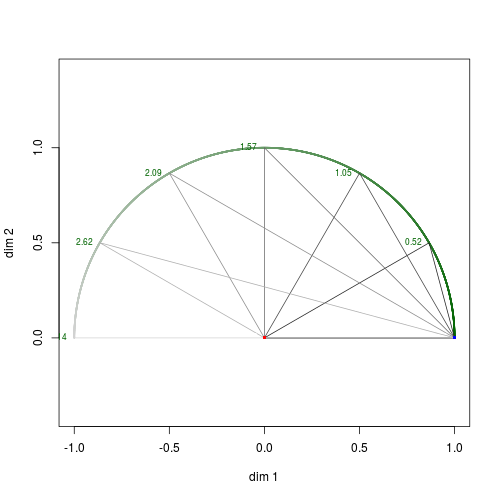
Here is the map when $t \in (0, \pi)$:
The initial triplet $(0, 1, e^{it})$
And the mapping to adherent points:
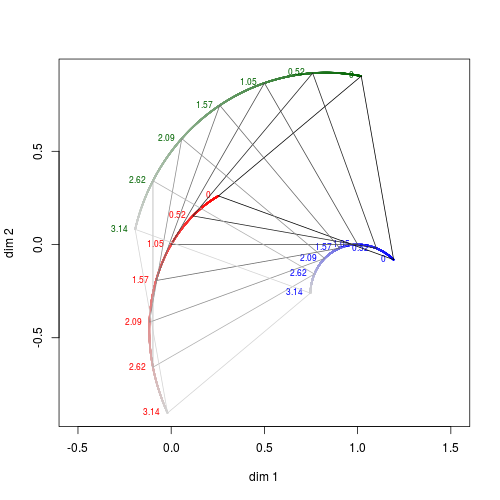
Note that triplet corresponding to $t = \pi / 3 \approx 1.05$ is equilateral, so it remains unchanged by the mapping.