I'm teaching an introduction to Group Theory to clever 16 year olds. I'm producing a table of all groups of order less than 12 and am searching for an example of each group.
I've got one blank left in my table which is for an example of $\mathbb{Z}_3 \times \mathbb{Z}_3$. Alas, the otherwise excellent source at https://nathancarter.github.io/group-explorer/GroupExplorer.html says there are "none".
However it says the same for $\mathbb{Z}_4 \times \mathbb{Z}_2$; the following post on MSE How to compute the rational group of this elliptic curve? helped me fill in that blank. (It is, admittedly, not an example that my 16 year olds will understand!)
So, my question is, does anyone have an "concrete" example in which the group $\mathbb{Z}_3 \times \mathbb{Z}_3$ occurs ?
It's mostly to satisfy my own curiosity.

Imagine a slidey table whose surface is a 3x3 grid of nine squares, somewhat like one side of a Rubik's cube, but with different mechanics.
There are two horizontal moves you can make which slide the squares to the right or to the left, but as the reach the edge of the table they slink around to the other side.
Right = $\begin{array}{|c|c|c|} \hline \rightarrow & \rightarrow & ⮌ \\ \hline \rightarrow & \rightarrow & ⮌ \\ \hline \rightarrow & \rightarrow & ⮌ \\ \hline \end{array}$ and Left = $\begin{array}{|c|c|c|} \hline ⮎ & \leftarrow & \leftarrow \\ \hline ⮎ & \leftarrow & \leftarrow \\ \hline ⮎ & \leftarrow & \leftarrow \\ \hline \end{array}$
There are two vertical moves you can make, up and down, where again the top row will slide swiftly under the table back to the bottom row when you use up, and in reverse for down.
Up = $\begin{array}{|c|c|c|} \hline ⮏ & ⮏ & ⮏ \\ \hline \uparrow & \uparrow & \uparrow \\ \hline \uparrow & \uparrow & \uparrow \\ \hline \end{array}$ and Down = $\begin{array}{|c|c|c|} \hline \downarrow & \downarrow & \downarrow \\ \hline \downarrow & \downarrow & \downarrow \\ \hline ⮍ & ⮍ & ⮍ \\ \hline \end{array}$
These moves can be combined, to do Up-Left, or Down-Right, or even the sillier Up-Down. How many combinations are there? In some sense, there are infinitely many. Up, Up-Up, Up-Up-Up, ... but what happens when you use Up three times in a row? Everything is back to the starting point, just a little dizzy.
How many distinct positions can you move the game board into using just the four moves Right, Left, Up, Down?
The answer is 9, and the group generated by these moves is $\mathbb{Z}_3 \times \mathbb{Z}_3$.
This object is called its Cayley graph and the permutation representation is called the regular representation.
Another use of $\mathbb{Z}_3$ that was popular in math departments was the card game Set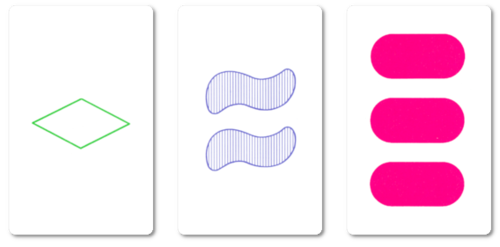
A relatively quick way to play is to view each aspect as a direction on the table, and multiply cards together according to the these rules. This is the group $\mathbb{Z}_3 \times \mathbb{Z}_3 \times \mathbb{Z}_3 \times \mathbb{Z}_3$ (color, number, shape, fill).