What is the ratio of the side length of a regular hepatgon to the side length of the internal heptagon?

549 Views Asked by At

Given a regular heptagon with side length 1, create a star heptagon by connecting every vertice.
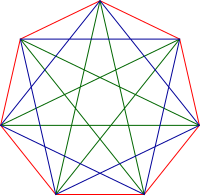
star heptagon

Note that removing the "points" of the star yields a similar heptagon. I want to know the side length of this internal heptagon (blue sides) in relation to the side length of the original heptagon.

The blue lines: $$ \rho = 2cos(\pi/7) $$ The green lines: $$ \sigma=4cos^2(\pi/7) - 1 $$

[Golden Fields: A Case for the Heptagon, Peter Steinbach, Albuquerque Technical-Vocational Institute, Mathematics Magazine, Vol. 70, No. 1, February 1997]

No idea where to start :(

2

There are 2 best solutions below

3
On

Refer to the following diagrams:-

enter image description here

0
On

Thank you Mick for the approach.

Given: $\sigma = 4cos^2(\pi/7) - 1 $ , $\rho = 2cos(\pi/7)$

Law of Cosines $$ c^2 = a^2 + b^2 - 2ab*cos(C) $$

Law of Sines $$a /sin(A) = b / sin(B) = c/sin(C)$$

Since $ \sigma $ and $\rho$ are given, we can subsitute these in for a, b, and c to determine angle C (which I will call $\theta$ from here on) $$ \sigma^2 = \rho^2 + \rho^2 - 2(\rho)(\rho)cos(\theta) $$ $$\sigma^2 = 2\rho^2 - 2\rho^2cos(\theta) $$ $$ \sigma^2 / 2\rho^2 = 1 - cos(\theta)$$ $$ cos(\theta) = 1 - \sigma^2/2\rho^2$$ $$ \theta = arccos(1 - \sigma^2/2\rho^2)$$ $$ \theta = arccos(1 - ((4cos^2(\pi/7)-1)^2/2(2cos(\pi/7))^2))$$ $$ \theta \approx 1.3463968515384828164839900214055012360845011711607596$$

Now, with $\theta$, and the knowledge that the interior angle of a regular heptagon is $5\pi/7$, we can use the law of sines to determine the blue star's side length. The triangle, which is formed by the large heptagon's side length and the blue star's side lengths, is isosceles, and the base angles (i'll call them $\gamma$) are $(5\pi/7 - \theta)/2$. The vertex angle is equivalent to $\pi - (5\pi/7 - \theta)$, and i will call this $\beta$. We know that the red side length is 1. By the law of sines, the blue star side length (i'll call this $\delta$).

This gives:

$$\delta / sin(\gamma) = 1 / sin(\beta) $$ $$\delta = sin(\gamma)/sin(\beta) $$ $$\delta = sin(1/2(5\pi/7-arccos(1-(4 cos^2(\pi/7)-1)^2 /(2(2cos(pi/7))^2))))/sin(2\pi/7+arccos(1-(4 cos^2(pi/7)-1)^2/(2 (2 cos(pi/7))^2))) $$ $$\delta \approx 0.5549581320873711914221948710064104810672888624709100 $$

Back to the law of cosines a final time to find the length we're primarily interested in. This time, $\theta$ is known, and the congruent side lengths $\delta$ are known. We'll call the final answer, the small heptagon side length $x$.

$$ x^2 = \delta^2 + \delta^2 - 2(\delta)(\delta)*cos(\theta) $$ $$ x^2 = 2\delta^2 - 2\delta^2cos(\theta) $$ $$ x = (2\delta^2(1-cos(\theta)))^.5 $$ $$ x = \delta(2-2cos(\theta)^.5 $$

Therefore, $x$ is exactly:

$$ (-1/4 (4 cos^2(\pi/7)-1)^2 sec^2(\pi/7))^.5(sin(1/2 (5\pi/7-arccos(1-(4 cos^2(\pi/7)-1)^2/(2 (2 cos(\pi/7))^2)))))/(sin(14\pi/49+arccos(1-(4 cos^2(\pi/7)-1)^2/(2 (2 cos(\pi/7))^2)))) $$

or for practical purposes:

$$ x \approx 0.692021471630095869627814897002069140197260599321894 $$