I would like to solve the following integral equation for $g(z)$. $$\int_z^\infty g(\zeta)(\zeta-z)^{\alpha-1} d\zeta = e^{-bz}, \tag{1}$$ where $\alpha$ and $b$ are constants.
I would also like to know the techniques for solving $g$ in the more general equation $$\int_z^\infty g(\zeta)h(\zeta-z) d\zeta = f(z), \tag{2}$$ for known $f$ and $h$.
We can put the second equation in the alternative form $$\int_0^\infty g(z(x+1))h(x) dx = f(z). \tag{3}$$ I do not know if it helps though.
I put equation $(2)$ into the form $$\int_{-\infty}^\infty g(\zeta)\Theta(\zeta-z)h(\zeta-z) d\zeta = f(z),$$ where $\Theta$ is the Heaviside step function, which suggests using Fourier transform applied to convolution. However, for the kind of $h$ and $f$ as in equation $(1)$, the Fourier transform $F[g](k) = \int_{-\infty}^\infty g(x)e^{ikx}dx$ is divergent thus not readily defined. Perhaps I need to get $k$ into the complex plane to make the transform sensible for those kinds of functions.
I have tried the Laplace transform which is a special case of Fourier transform. It does not appear to work because of the limits of the integration. Maybe someone can transform the form of the integral to make it work.
Perhaps there is a more direct method. Any ideas?

Consider $$\int_z^\infty g(\zeta)(\zeta-z)^{\alpha-1} d\zeta = f(z), \tag{1}$$ where Re$(\alpha)>0$.
For now we assume $f(z)=0$, for $z<0$.
Rewrite equation $(1)$ as $$\int_{-\infty}^\infty g(\zeta)(\zeta-z)_+^{\alpha-1} d\zeta = f(z), \tag{1.1}$$
Fourier transform equation $(1.1)$. $$F[x_+^{\alpha-1}](-k)F[g](k) = F[f](k), \tag{2}$$ where $F[f](k)$ stands for the Fourier transform in complex variable $k$ of function $f$. The difficulty mentioned in the question regarding the convergence of Fourier transform of functions like the exponential function can be circumvented either by limiting first the support of the function to, say, the positive axis, or expand the function space to Gelfand-Shilov space, or simply forge ahead without worrying about the convergence at all.
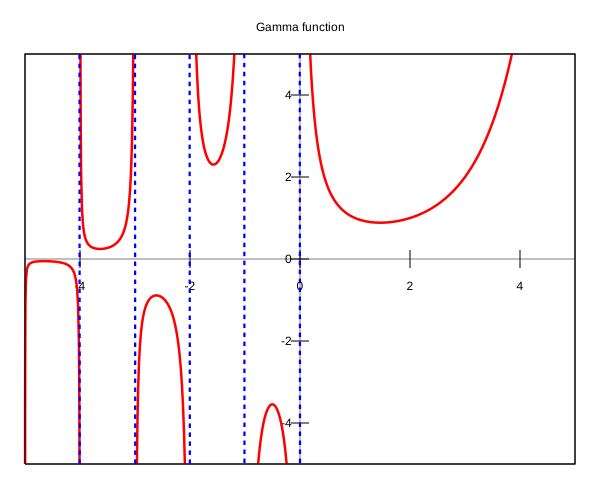
$$F[x_+^{\alpha-1}](-k) = \int_0^\infty e^{-ikx}x^{\alpha-1} dx = (ik)^{-\alpha}\Gamma(\alpha), \,\mbox{Im}(k)<0, \tag{3}$$ where the contour is deformed to the real axis.
$$F^{-1}\Big[\frac{(ik)^\alpha}{\Gamma(\alpha)}\Big](x) = \frac{1}{\Gamma(\alpha)\Gamma(-\alpha)}(-x)_+^{-\alpha-1}. \tag{4}$$ Therefore, $g$ would be the convolution of the product of $(4)$ and $f$, or
$$g(x) = \frac{1}{\Gamma(\alpha)\Gamma(-\alpha)}\int_0^\infty y^{-\alpha-1}f(x+y)dy$$ (to be continued, as the left limit does not converge, and thus there should be another term to cancel the singularity.)
The following is a direct method that is inspired by the above Fourier transform.
Integrate both side with respect to $dz(x-z)^{\beta-1}$, Re$(\beta)>0$ $$\int_x^\infty dz (z-x)^{\beta-1}\int_z^\infty g(\zeta)(\zeta-z)^{\alpha-1} d\zeta =\int_x^\infty d\zeta g(\zeta)\int_x^\zeta dz (z-x)^{\beta-1}(\zeta-z)^{\alpha-1}=\int_x^\infty dz (z-x)^{\beta-1}f(z),$$ where the first equality comes from changing order of integration (by checking the conditions of Fubini's theorem which may require more regularity conditions on $g$ which I am going to do right now). $$\int_x^\zeta (z-x)^{\beta-1}(\zeta-z)^{\alpha-1}dz = (\zeta-x)^{\alpha+\beta-1}\int_0^1 t^{\beta}(1-t)^\alpha dt=(\zeta-x)^{\alpha+\beta-1} B(\beta,\alpha),$$ where $B$ is the Beta function. So by setting $\beta=1-\alpha$, we shall have $$B(1-\alpha,\alpha)\int_x^\infty d\zeta g(\zeta) = \int_0^\infty z^{-\alpha}f(x+z)dz,$$ and $$g(x) = -\frac{1}{B(1-\alpha,\alpha)}\int_0^\infty z^{-\alpha}f'(x+z)dz. \tag{2}$$
For the original problem $f(z) = e^{-bz}$, equation $(2)$ becomes $$g(x) = \frac{b^\alpha e^{-bx}}{\Gamma(\alpha)},$$ where $\Gamma$ is the Gamma function.
Therefore, it turns out $e^{-bz}$ is an eigenfunction of the integral operator $\int_z^\infty d\zeta (\zeta-z)^{\alpha-1}g(\zeta)$ on function $g(z)$.