I'm working on Mondrian Process [paper], which in few words splits a boxed region in $R^d$ by axis-aligned hyperplanes, uniformly located on a random axis, chosen proportionally to the lenght of the axis itself.
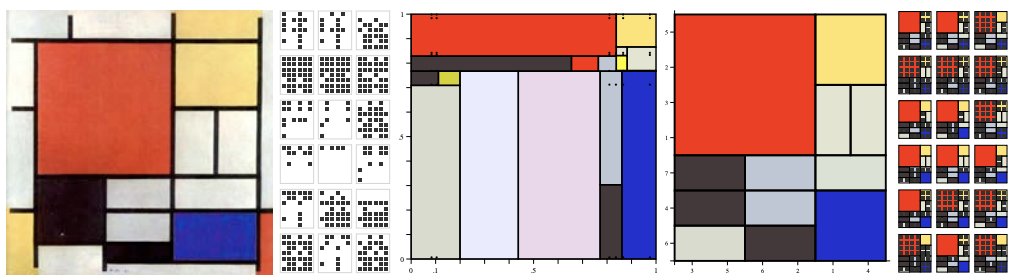
Now, I would like to compute the expected semi-perimeter for further produced cells.
Firstly, I performed some simulations, obtaining the following result:
$L_{t+1} = \frac{d}{d+1} L_t $
where $L_{t+1}$ is the average semi-perimeter for the average sub-cell $L_{t}$. I also noticed that independently by the shape of the original region (proportion between the lenght of sides), the ration between average perimeter at each "depth" converges to that factor.
Now I want to reproduce this result analytically. I did for the simple case $d = 2$:
$E[X_{t+1} + Y_{t+1}] = E[E[B_x (X_t + y_t) + B_y (Y_t + x_t) \, | \, x,\, y\,]]$
Here, $B_x$ is a Bernoulli r. v. that describes the axis choice, and $E[B_x] = \frac{x}{x+y}$; while $X_t$ is uniformly distrubuted in $[0, \,x_t]$ where x_t is the lenght of the the x-side. The same holds for $y$.
Then (with little abuse of notation)
$ E[X_{t+1} + Y_{t+1}] = E[\,E[B_x]\;E[X_t + y] + E[B_y]\;E[Y_t + x]\,] = \\ = E[\, \frac{x}{x+y} (\frac{x}{2} + y) + \frac{y}{x+y}(\frac{y}{2} + x)\,] = \\ = E[\, \frac{1}{2} \frac{x^2 + y^2 + 4xy}{x + y} \,] = \\ = E[\, \frac{1}{2} (x + y) + \frac{xy}{x+y} \,] = \quad \quad \text{(assuming } x+y = 1 \text{ for simplicity)} \\ = E[\frac{1}{2} + xy] = \\ = E[\frac{1}{2} + x(1-x)] = \frac{2}{3} \quad\quad \text{since } x \sim U([0, 1]) $
I tried with $d$ generic dimensions, like this
$ E[\sum x_i^{(t+1)} ] = E[\, \sum E[B_{x_i}] E[ X_i + \sum_{x \neq x_i} x_i ]\,] = \\ = E[\, \sum \frac{x_i}{\sum x_i} (\frac{x_i}{2} + \sum_{x \neq x_i} x_i )\,] = \\ = E[\, \frac{1}{2} \frac{\sum x_i^2 + 2 (\sum x_i (\sum_{x \neq x_i} x_i ))} {\sum x_i }\,] = \\ = E[\, \frac{1}{2} \frac{\sum x_i^2 + 4 \sum_{i \neq j} x_i x_j} {\sum x_i }\,] = \\ = E[\, \frac{1}{2} \frac{(\sum x_i)^2 + 2 \sum_{i \neq j} x_i x_j} {\sum x_i }\,] = \\ = E[\, \frac{1}{2} (\sum x_i) + \frac{\sum_{i \neq j} x_i x_j} {\sum x_i }\,] = \quad \quad \text{(assuming as above } \sum x_i = 1 )\\ = E[\, \frac{1}{2} + \sum_{i \neq j} x_i x_j\,] $
But here I can't continue. Any help?