Find the minimum value of $|CD|$.

91 Views Asked by At

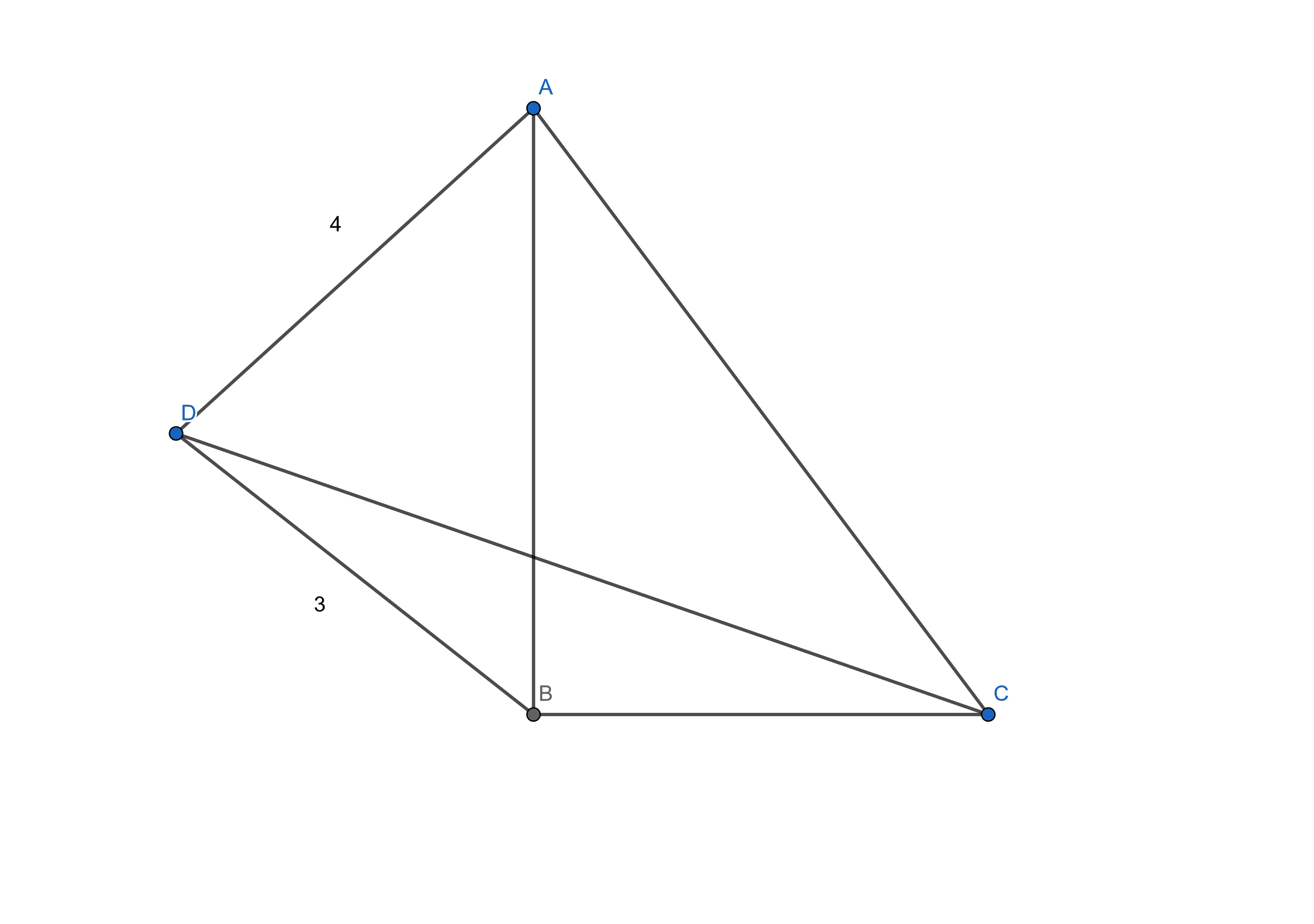
As shown in the figure, $\angle ABC = 90,tan\angle BAC = \dfrac{3}{4}$,point $D$ is on the left of $AB, |AD|=4,|DB|=3$
Find the minimum value of $|CD|$.

I first tried to construct a triangle with AB as a side similar with $\triangle DBC$, because $\dfrac{|BC|}{|AB|}=\dfrac{3}{4}$. And I think it may be a possible solution.
I hope to find more solutions.
3

There are 3 best solutions below

2
On

enter image description here

Comment: minimum of CD is when $\angle ADB\rightarrow 0$ . in this case we have:

$AB=1$

$BC=\frac 34 \times 1 =0.75$

and BC is perpendicular on DB and we have:

$DC=\sqrt{(DB=3)^2+(BC=0.75)^2}=3.092\approx 3.1$

0
On

Note that by triangle inequality in $\triangle ABD$ we know that $x\geq 1$, where $x$ is the length of $AB$. Let $\mu(\widehat{DBA})=:\phi$. By assumption $\phi\in[0,\pi]$ and $BC=\frac{3}{4}x$ .

Observe that when $\phi=0$, $x=7$ and when $\phi=\pi$, $x=1$. It is not difficult to observe that $x$ as a function of $\phi$ is decreasing. Now take the point $D'$ to be corresponding to $\phi=\pi$, i.e., $D'$ is colinear with $A$ and $B$ and is 'below' $B$ such that $BD'=3$. Also take $C'$ on the segment $BC$ such that $BC'=\frac{3}{4}$. Also note that $C'D'=\frac{3}{4}\sqrt{17}$ by Pythagoras in $\triangle BD'C'$ and this is the value of $CD$ when $\phi=\pi$.

Now we show that we cannot do better.

Step 1: Examine $\frac{\pi}{2}\geq \phi\geq 0$. In this case, $x\leq x(\frac{\pi}{2})=\sqrt{7}$ by Pythagoras in $\triangle DBA$. But applying triangle inequality in $\triangle CBD$, we see that $CD\geq 3+\frac{3}{4}\sqrt{7}>\frac{3}{4}\sqrt{17}$.

Step 2: Assume that $D\neq D'$ corresponds to $\phi\in(\frac{\pi}{2},\pi)$. This implies $\phi<\pi$ and the $x$ corresponding to $D$ is greater than $1$. In particular this also implies that $BC>BC'$. Therefore $CD>C'D$. But now $\mu(\widehat{C'BD})>\frac{\pi}{2}$ so $C'D>C'D'$ since in the triangles $\triangle C'BD$ and $\triangle C'BD'$ we have $BD=BD'$, $BC'$ is a common edge but $\mu(\widehat{C'BD})>\mu(\widehat{C'BD'})$. Therefore $CD>C'D'$.

So $CD$ is minimized when $D=D'$, implying $x=1$, $BC=\frac{3}{4}$ and $CD=\frac{3}{4}\sqrt{17}$.

2
On

Edit: I missed earlier that if $C$ and $D$ are on opposite sides of $AB$ then the previous answer already has a solution. I was curious to find the minimum value of |CD| without that restriction.

One of the observations after drawing the diagram is that $|CD|$ is minimum when the line through points $C$ and $D$ is tangent to the circle with center at $A$ and radius of $4$. However I cannot clearly establish if and why that would always be the case. If you can establish that, ABCD becomes a cyclic quadrilateral and applying Ptolemy, it is straightforward that $|CD| = \dfrac 34$.

Here is a diagram that shows the set up when $|CD|$ is minimum and the below solution uses elementary calculus.

enter image description here

Say $B$ is the origin and $A$ and $C$ are on y-axis and x-axis respectively. As $|BD| = 3$, coordinates of $D$ is $(3 \cos \theta, 3 \sin\theta)$. Also, coordinates of $A$ and $C$ can be written as $(0, 4k)$ and $(3k, 0)$ respectively.

$AD^2 = x^2 + (y-4k)^2 = (3 \cos \theta)^2 + (3 \sin \theta - 4k)^2 = 16$

$16 k^2 = 24 k \sin\theta + 7 \tag1$

$CD^2 = (x-3k)^2 + y^2 = 9 (k^2 - 2 k \cos\theta + 1) \tag2$

To minimize $|CD|$, we need to minimize $CD^2$.

From $(1)$, $ \sin\theta = \dfrac{16k^2 - 7}{24k}$

$ \displaystyle \cos \theta = \pm \frac{\sqrt{800k^2 - 256 k^4 - 49}}{24k}$

We can observe that point $D$ will be closer to point $C$ if they are on the same side of y-axis. So,

$ \displaystyle CD^2 = f(p) = 9 \left(p + 1 - \frac{\sqrt{800 p - 256 p^2 - 49}}{12}\right) \tag3$

where $p = k^2$.

Taking derivative and equating to zero, we get

$ \displaystyle \sqrt{800 p - 256 p^2 - 49} = \frac{100 - 64 p}{3} \tag4$

Squaring and solving the quadratic, $p = \dfrac{53}{80}$

Plugging $(4)$ into $(3)$,

$ \displaystyle CD^2 = 25 p - 16 = \frac{9}{16} \implies |CD| = \frac 34$