Game Theory Voting Utilities

1.2k Views Asked by At
  1. We have three players, $1,2,$ and $3 .$ They must vote between three options, $a, b,$ and c. Their utilities for these three options are:
    \begin{array}{llll} & 1 & 2 & 3 \\ a & 3 & 2 & 1 \\ b & 2 & 1 & 3 \\ c & 1 & 3 & 2 \end{array}
    Note: This is not the normal form $-$ it's just a table for summarizing the utilities. Each agent cares only about the outcome, not what he votes for. So, for example, if $a$ wins, regardless of how it wins, 1 's utility is 3,2 's utility is $2,$ and 3 's utility is $1 .$

The voting is by secret ballot. Each player votes for one alternative. The outcome is determined by majority rule whenever possible, so if any option gets two or more votes, it wins. If there is a three-way tie, the winner is whatever outcome player 1 voted for.

Write this as a game in normal form. Find the pure strategy Nash equilibria. Is this game dominance solvable? If so, what is the solution?

So far, I've managed to come up with this solution:

!
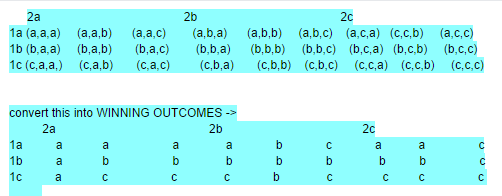
But as far as here...I can convert this into payoffs, however I'm unsure of how to figure out the Nash equilibria as when we convert from Player 1->3 it starts to confuse me. Any clear answer will be much appreciated. Thanks!

3

There are 3 best solutions below

1
On

@boutiquebankerecon - I could be wrong but....

I was under the impression that a Nash Equilibria relied on the fact that no player can do better by unilaterally changing their strategy. As the voting is secret there is no opportunity to change your strategy - so I don't think there can be a Nash Equilibria?

The introduction of player 1 having the "super vote" in a tie also biases the outcome. Effectively player 1's vote will be the winner 7/9 of the time so player 1 should always vote a. If the other players vote rationally, a wins.

However, if you vote repeatedly, player 1 and 2 should ultimately settle on voting for c because that give them the largest collective utility. Because this is then a repeated game I don't think it can be considered to be a Nash Equilibria?

0
On

I think it is dominance solveable when iterated as the players would rationally eliminate the dominated strategies. Ignoring the fact that the vote is supposedly secret, the rounds should go as follows:

Round 1. everyone votes for their 3 (so player 1 wins), Round 2. player 2 shifts to c (so players 2 & 3 win), Round 3. player 1 shifts to c (so all players win).

We are now at an equilibrium - if any one player changes they will lose out.

As an alternative:

Round 2 player 3 shifts to b (so players 2 & 3 win), Round 3 player 1 shifts to b (so all players win).

We are now at another equilibrium.

Finally:

Round 2 player 2 shifts to a (so players 1 & 2 win), Round 3 player 3 shifts to a (so all players win).

We are again at an equilibrium.

The equilibriums are Nash equilibriums - but only because they have to have knowledge of the other players strategy. If it is a secret vote they only know the outcome and not the other players strategy - so cannot respond to it.

0
On

Here is my full matrix of scores (on right is the key).

Matrix of choices

You will note player 1 only loses two times out of nine, whereas the other two players lose four times out of nine. The only way they can improve their position is by co-operating. This is negated if the voting is secret.

The Nash equilibrium requirement of being aware of the other players strategies is negated if voting is secret, so there is technically no Nash equilibrium. However, if you do not make the voting secret then player 1 (who is mildly dominant) can be manoeuvred by the other two players who should eliminate their dominated strategies, resulting in player 2 & 3 voting the same, which will force player 1 to also follow suit. Hence if the voting is not secret it is dominance solveable and there are three potential Nash equilibria where all three players vote the same way.