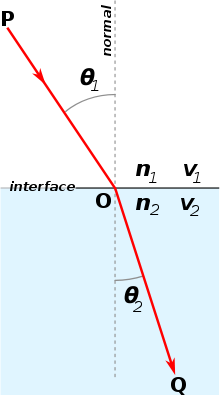
Geometrical construction for Snell's law?

4k Views Asked by At

Snell's law from geometrical optics states that the ratio of the angles of incidence $\theta_1$ and of the angle of refraction $\theta_2$ as shown in figure1, is the same as the opposite ratio of the indices of refraction $n_1$ and $n_2$.

$$ \frac{\sin\theta_1}{\sin \theta_2} = \frac{n_2}{n_1} $$

figure 1

(figure originally from wikimedia)

Now let $P$ be a point in one medium (with refraction index $n_1$) and $Q$ a point in the other one as in the figure. My question is, is there is a nice geometrical construction (at best using only ruler and compass) to find the point $O$ in the figure such that Snell's law is satisfied. (Suppose you know the interface and $n_2/n_1$)?

Edit A long time ago user17762 announced to post a construction. However until now no simple construction was given by anybody. So, does anybody know how to do this?

3

There are 3 best solutions below

1
On

Yes. I guess there is.

Draw perpendicular from point P to interface say PP'. Draw perpendicular from point Q to interface say QQ'.

Divide segment P'Q' in ratio n_2/n_1.

O is the point that divides P'Q' in n_2/n_1.

2
On

If you know the interface, then drop perpendiculars from $P$ and $Q$ to the interface. Let the points of intersection be $P'$ and $Q'$. Let $PP' = y_P$ and $QQ' = y_Q$.

Now consider the line segment $P'Q'=x$. You need to find a point $O$ inside $P'Q'$ such that $OP' + OQ' = x$.

Let $OP' = x_P$ and $OQ' = x_Q$. enter image description here

We now have two equations to solve for $\theta_1$ and $\theta_2$.

$x_P + x_Q = x$ i.e. $$y_P \tan(\theta_1) + y_Q \tan(\theta_2) = x$$

and

$$\frac{\sin(\theta_1)}{\sin(\theta_2)} = \frac{n_2}{n_1}$$.

So the problem is well-defined and hence solving for $\theta_1$ and $\theta_2$ gives $x_1$ and $x_2$.

I shall post the geometric construction later.

0
On

Yes, right. When entering a denser medium light slows down.. Adding another answer keeping only to the construction method. Drawn on Geogebra, removed the axes and grid to trace a ray inside a medium of higher refractive index $\mu$.

Choose an arbitrary point X such that

$$ \mu= \dfrac{XP}{XQ} \left( =\dfrac{n_2}{n_1}=\dfrac{v_1}{v_2} \right) $$

which is possible using Ruler & Compass using suitable segment lengths.

From $X$ draw bisector to angle $PXQ$ cutting interface at $O,$ which is the required point of incidence. Due to refraction, the point of incidence $O$ always shifts to the right, when stat point $P$ is at top left, compared to the straight unrefracted ray $PQ$ point of impingement on interface.

The ratio of sides and times spent in each medium is maintained due to the constant bisector property of Apollonian Circle ( no need to draw it).

The diagram represents a lightray refraction into a medium of refractive index 1.5

enter image description here