Is there a theory explaining how a cellular automata can propagate signals in straight lines?
For example, this video shows how some "signals" travel down at a diagonal, even though they are composed of 5 white cells.
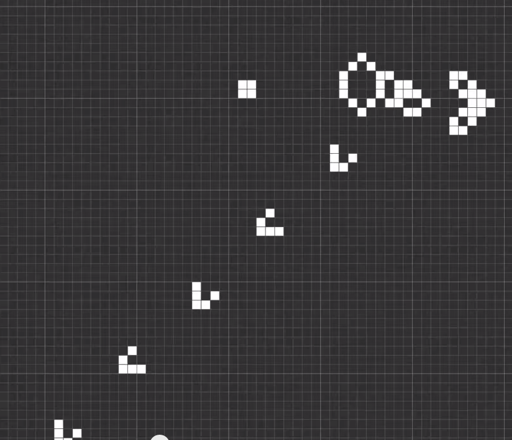
What I'm wondering is, has any work been done to describe the different cases or general models for how different numbers of "white cells" can travel in different angles in a grid? So in the video, there are 5 white cells, traveling at roughly a 45 degree angle. But what about 6 white cells, what about 20, or even just 1? And what about a 44 degree angle, or a 44.995 degree (some very precise) angle? What are the general patterns for how the cells move at each step?
Basically, what would the rules be for those types of "signal propagations", or general formulas based on angle and number of cells, how to make it move along a path. That sort of thing. Has any work been done in this area?

From the computer science point of view, there is a survey by Marianne Delorme and Jacques Mazoyer: Signals on Cellular Automata.
From the dynamical system point of view, people sometimes talk about defects or particles or kinks, which are similar to what you would call a signal. See for example the relevant section of this survey by Marcus Pivato and the references therein.
You could also check out this (and related) articles by James Hanson and James Crutchfield on what they call the computational mechanics of cellular automata.