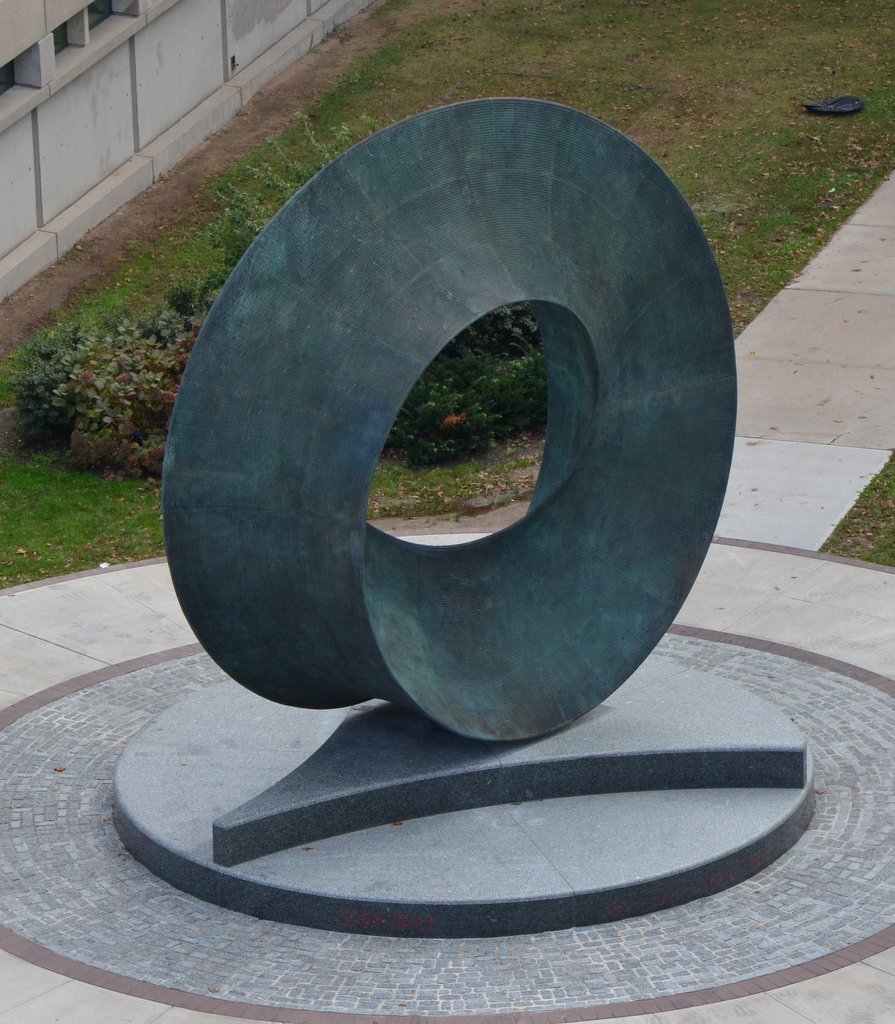
Here are two images - one of each. It seems to me that they are the same object from the topological perspective, that one is just a smoothed-out version of the other. I think this because it is clear each has one side face, an enclosed body, triangular cross-sections etc. I guess I'm thinking loosely in terms of simplicial homology.
The Penrose Triangle
The Umbilic Torus
http://scgp.stonybrook.edu/wp-content/uploads/2012/10/UmbilicTorus-aerialview-web.jpg
To be fair, I cannot determine by just inspection if the Penrose triangle has a single edge or not - and if this would be enough to distinguish them topologically - and it's not like I can go out and look at one to determine if it's really the same as the umbilic torus on campus.
Can anyone with a good visualization ability or maybe just more knowledge of homology help me determine the homology groups of the Penrose triangle? Or if not, is there perhaps some easier way to see if they are distinct?


These are topologically both the same. Indeed both are homeomorphic to a solid torus $S^1 \times D^2$, and hence are homotopy equivalent to a circle: you can imagine shrinking each cross-section down to a point.
The edges/faces thing is irrelevant from the point of view of topology. For example the unit square $[0, 1]\times [0, 1]$ is homeomorphic to the disc $D^2$ despite having different numbers of corners/sides.
The Penrose triangle has two edges and a square cross-section.