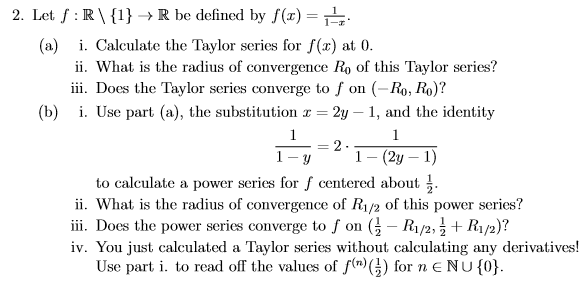
Part (A) (i) Asks for the Taylor Series of $f(x)$, when we have $f(x) = 1/(1-x)$.
We can take the derivative of $f(x)$ repeatedly and see that: $$ f(x) = 1/(1-x) = 0!/ (1-x)^1$$ $$ f'(x) = 1/(1-x)^2 = 1!/ (1-x)^2$$ $$ f''(x) = 2 / (1 - x)^3 = 2! /(1-x)^3$$ $$ f'''(x) = 6 / (1-x)^ 4 = 3! / (1-x)^4 $$
So, we can see that
$$ f^n (x) = n!/(1-x)^{n+1} $$
By Taylor's Theorem, we see that the Taylor Series of $f(x)$ centered at $0$ is
$$\sum (n!/(n!(1-0))) * x^n $$ $$ = \sum x^n $$
The radius of convergence is just $R = 1$ since $a_n = 1$, and we can see that the Taylor Series obviously converges to f on its radius of convergence.
I haven't got the slightest clue how to do part (b), mainly how to find the power series using those formulas without computing the derivative.
This is homework I didn't finish and the professor didn't post the solutions afterwards so it'd be most appreciated if someone could fill me in ASAP! Thanks.

For $y\in(0,1)$, we have that $$f(y)=2f(2y-1)$$ Moreover, for all $x\in (-1,1)$, $$f(x)=\sum_{n=0}^{\infty}x^n$$ Thus, \begin{align}f(y)&=2\sum_{n=0}^{\infty}(2y-1)^n\\ &=\sum_{n=0}^{\infty}2^{n+1}(y-{1\over2})^n \end{align} which is the Taylor series for $f$ at $1\over2$.