What exactly are dual basis vectors such as those which arise in non-orthogonal co-ordinate systems? What is their physical interpretation.
Please note, I don't know much tensor calculus yet. I am in fact interested in them because of their connection with the reciprocal lattice in solid state physics.
However I could not get a satisfactory answer in physics SE hence I am hoping to get a better insight from mathematicians.
Thank you.

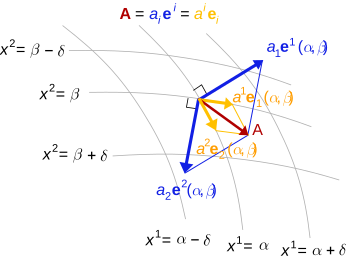
The simplest explanation is the following: Given a basis $({\bf e}_i)_{1\leq i\leq n}$ of some vector space $V$ over a field $F$ each vector ${\bf x}\in V$ gets coordinates $x_i\in F$ $\>(1\leq i\leq n)$ with respect to that basis: $${\bf x}=\sum_{i=1}^n x_i{\bf e}_i\ .$$ In fact, for each $i$, the $i^{\rm th}$ coordinate of ${\bf x}$ depends linearly on ${\bf x}$. This means that we have $n$ linear functionals $$\phi_i:\quad V\to F,\qquad{\bf x}\mapsto x_i\qquad(1\leq i\leq n)\tag{1}$$ which compute the $n$ coordinates of any input vector ${\bf x}$. These $\phi_i$ together constitute the dual basis of $({\bf e}_i)_{1\leq i\leq n}$, and are denoted by ${\bf e}_i^*$ (or similar). We therefore may replace $(1)$ by $${\bf e}_i^*:\quad V\to F,\qquad{\bf x}\mapsto x_i\qquad(1\leq i\leq n)\ .$$ It is then obvious that ${\bf e}_i^*\bigl({\bf e}_k\bigr)=\delta_{ik}$ (Kronecker-Delta), since ${\bf e}_k$ has its $k^{\rm th}$ coordinate $=1$, and all other coordinates $=0$.